

UW Law professors have written or edited many books on a wide range of topics. This section of UW Law Digital Commons describes these works and, when possible, provides copies.
























-
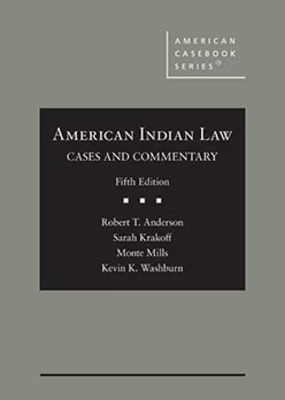
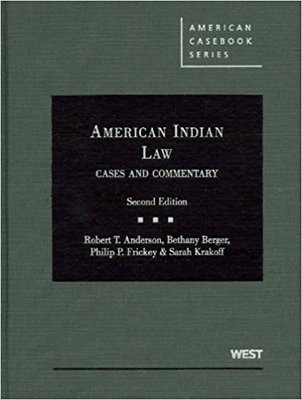
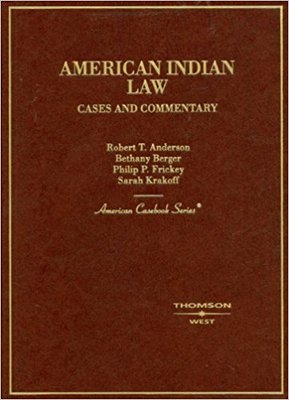
American Indian Law: Cases and Commentary
Robert T. Anderson, Sarah Krakoff, Monte Mills, and Kevin K. Washburn
This casebook provides a comprehensive examination of the legal relationships between American Indian tribes, their citizens, the federal government, individual states, and others. The book reviews the European colonization process that is at the root of the federal-tribal relationship. The U.S. Supreme Court’s foundational cases are incorporated with statutory text, background material, hypothetical questions, and discussion problems to structure the classroom experience and enhance student engagement. History is critical to understanding American Indian law as it now exists and it is covered and explained to highlight how it shapes current law. The fifth edition includes expanded materials on law and order within Indian country, the Indian Child Welfare Act, water rights, Hawaii, and Alaska as well as recent Executive Branch actions that increase tribal authority. The authors update the book with a supplement after the end of the Supreme Court’s term every summer.
-
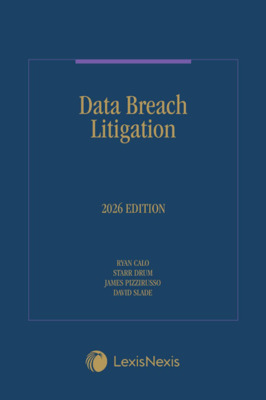
Data Breach Litigation
Ryan Calo, Starr Drum, James Pizzirusso, and David Slade
Data Breach Litigation is a practitioner treatise analyzing the legal, regulatory and litigation landscape arising from modern data breaches, from technical foundations to standing, damages and evolving case law. It provides guidance on state and federal frameworks, class actions and enforcement trends to support attorneys counseling clients and litigating in this developing area.
-
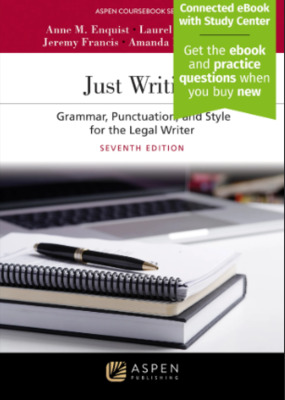
Just Writing: Grammar, Punctuation, and Style for the Legal Writer (7th ed.)
Anne Enquist, Laurel Currie Oates, Jeremy Francis, and Amanda K. Stephen
Just Writing: Grammar, Punctuation, and Style for the Legal Writer, Seventh Edition, features the authors’ famously effective step-by-step approach to writing and editing legal documents effectively. With numerous examples, including briefs and memos, Just Writing walks students through the process of drafting and revising legal writing to make the argument and language as correct and clear as possible. This text also discusses the expectations of legal writing and argument in American and other cultures, as well as a chapter devoted to helping ESL students develop their writing skills.
-

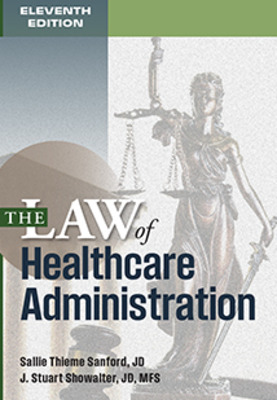
The Law of Healthcare Administration, 11th ed.
Sallie Sanford and J. Stuart Showalter
The Law of Healthcare Administration, 11th Edition,aims to provide future healthcare leaders with the most accurate, engaging, and practical guide to this complex area of law. Its extensively revised 15 chapters include coverage of the American legal system, medical malpractice law, tax exempt standards, fraud and abuse investigations, abortion regulation, healthcare initiatives undertaken by the second Trump administration, and more. Its new case law examples involve not only hospitals and physicians but also other institutional providers (such as community health centers and nursing homes) and individual allied health professionals (such as pharmacists and nurse practitioners).
-
The Law and Theory of Patents
Toshiko Takenaka
This definitive comparative treatise provides a clear framework for understanding both the theory and practice of patent law. Grounded in the relevant international treaties such as the Agreement on Trade-Related Aspects of Intellectual Property Rights (TRIPS), the book identifies international obligations and draws out the common principles shared by patent systems across Europe and North America.
Beginning with a historical perspective, the book provides an analytical overview of patent law as a dynamic system shaped by digital transformation, and traces how the foundational doctrines of patent law have evolved and adapted to the realities of Industry 4.0, digital transformation, and AI innovation. In addition to delivering doctrinal analysis of the fundamentals of patent law, such as eligibility, novelty, inventive step, infringement, claim scope, remedies and defenses, the book also presents research questions inviting readers to examine how platform ecosystems, servitization, and AI tools challenge how these fundamentals are approached. It situates novel developments within the structure of traditional patent principles and concludes with forward-thinking research questions designed to stimulate future inquiries.
The Law and Theory of Patents is a crucial resource for scholars and students of patent law, innovation policy, and intellectual property (IP) law. Patent practitioners, judges, and regulators will also benefit from its comparative guidance and actionable insights into the complex future of patent law. -
Legal Writing and Analysis in a Nutshell, 6th Edition
Lynn Bahrych and Lauren E. Sancken
This book provides a five-step guide to clear, precise, and effective legal writing and analysis for law students, other legal writers, and experienced lawyers. The guide includes keys to writing legal memoranda and briefs, organizing analysis, crafting clear and concise sentences, using legal language accurately, using grammar and punctuation properly, and writing persuasively using classical rhetorical techniques. The book describes a method for analyzing and improving individual writing style. It also includes new material on using inclusive language and how to effectively and appropriately use the assistance of Artificial Intelligence for legal documents and new sample legal documents in the Appendix to illustrate effective writing techniques.
-
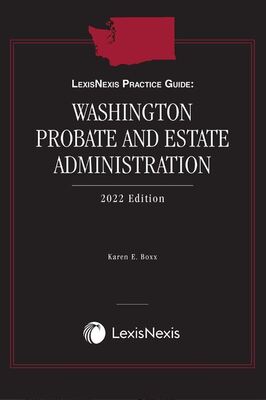
LexisNexis Practice Guide: Washington Probate and Estate Administration
Karen Boxx
LexisNexis Practice Guide: Washington Probate and Estate Administration is a practice-oriented resource designed to assist attorneys in guiding their clients through the probate and estate administration process. The author is a leading estates attorney in the state of Washington who has provided a wide variety of practice tips, examples and forms crucial to effective probate and estate administration in Washington. This practice guide includes in-depth analysis of topics such as: determining whether probate is necessary, identifying heirs and beneficiaries, creditors’ claims, and family protection.
-
Law and Technology: A Methodical Approach
Ryan Calo
Technology is difficult to study, let alone regulate. While law is uniquely positioned to channel technology toward human flourishing, technology poses special challenges to law and governance, obscuring human will and responsibility, stalling regulatory action, and putting rights and values into constant defense. The consequences can be dire. The United States spent three decades without a plan for nuclear waste disposal and still lacks comprehensive privacy laws many years into the information revolution. Law and technology as a field, meanwhile, has yet to cohere.
In light of these challenges, Law and Technology: A Methodical Approach offers a defensible and consistent approach to the legal analysis of technology, one capable of navigating technology's capacity to confuse and confound. Ryan Calo puts forward a step-by-step methodology for thinking about and ultimately challenging technology to meet society's demands. The book demonstrates that, no less than health law or law and economics, law and technology deserves a field of its own. To this end, it helps formalize legal analysis of physical and digital artifacts and systems, sowing the seeds for the concept of law and technology itself. -
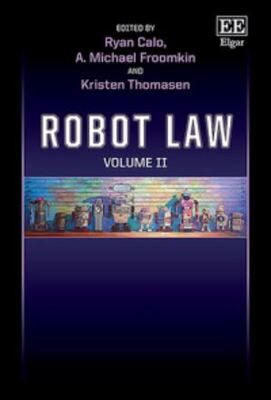
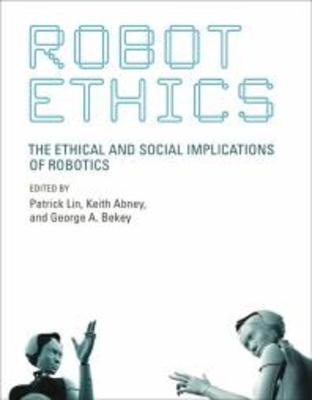
Robot Law: Volume II
Ryan Calo
An important sequel to the groundbreaking first edition, Robot Law: Volume II discusses the societal and economic transformations introduced by robotics. Editors Ryan Calo, A. Michael Froomkin and Kristen Thomasen, alongside their contributing authors, explore the legal, ethical, and societal challenges that robotics and automated systems pose, investigating the intersection of law and policy in this area.
Multidisciplinary authors provide a field-defining examination of years of transformative law and robotics scholarship. Presenting insightful perspectives on the societal risks and opportunities of robotics and artificial intelligence, authors focus on the legal and policy questions that robots present as well as their disruption of existing legal regimes. The book also offers a range of legal, policy, and ethical interventions to help channel robotics and AI in the public interest. Furthermore the book opens an important dialogue, underscoring the need to confront and mitigate the potential communicative or expressive harm that could be caused by this technology.
This book is an essential resource for law professors, students, practitioners, and jurists as well as engineering and AI students, academics, and researchers of robotics. Policymakers will find the interventions posed in this book valuable for developing strategies to address the impacts of robotics and AI. -
The Legal Writing Handbook: Analysis, Research, and Writing, Ninth Edition
Laurel Currie Oates, Anne Enquist, Jeremy Francis, and Amanda K. Stephen
The Legal Writing Handbook offers a complete resource on legal writing. Part I provides students with an introduction to the U.S. Legal System; Part II gives an overview of legal research, with both an introduction to sources and to research strategies; Part III introduces students to predictive memos, e-memos, and client letters; Part IV covers motion briefs; Part V offers an overview of appellate briefs; Part VI introduces oral advocacy; Part VII is a guide to effective writing; Part VIII is a guide to correct writing; and Part IX focuses on the needs of ESL writers.
-
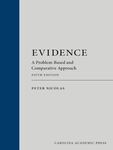
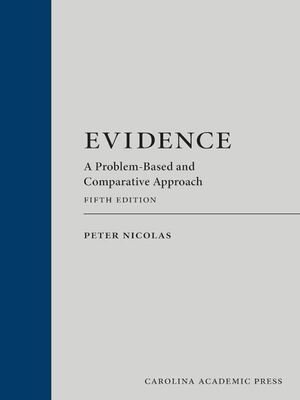
Evidence: A Problem-Based and Comparative Approach, Fifth Edition
Peter Nicolas
This casebook provides a comprehensive, problem-based approach to studying the rules of evidence. Organized around the federal rules, this casebook provides coverage of every single rule.
Key features of the casebook include approximately 120 in-depth problems that are designed to teach all the nuances of the rules, as well as coverage of selected state rules of evidence that differ significantly from the federal rules, in order to facilitate class discussion about the policies underlying the rules of evidence.
-
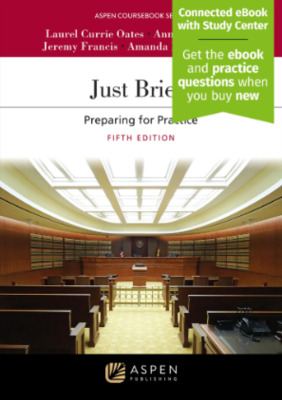
Just Briefs: Preparing for Practice (5th ed.)
Laurel Currie Oates, Anne M. Enquist, Jeremy Francis, and Amanda K. Stephen
Just Briefs: Preparing for Practice, Fifth Edition, features the authors’ famously effective step-by-step approach to writing both motion briefs and appellate briefs and to presenting an effective oral argument. Using numerous examples, Just Briefs walks students through the process of identifying arguments and a theory of the case, selecting an organizational scheme, presenting the facts, issues, and law in a light favorable to their client, and countering the other side’s arguments. Included in the book are annotated examples of briefs in support and opposition to a motion for summary judgment and appellate briefs on a federal issue.
-

Just Memos: Preparing for Practice (7th ed.)
Laurel Currie Oates, Anne M. Enquist, Jeremy Francis, and Amanda K. Stephen
Focusing on the process of writing both formal and less formal legal memos, Just Memos employs the same accessible approach that makes the authors’ flagship title, The Legal Writing Handbook, a perennial bestseller. Just Memos will help students transition from academic writing to legal writing with an introduction to the U.S. legal system, legal research, and legal analysis and reading. In addition, this concise text walks students through the process of writing predictive memos, e-memos, and opinion letters.
-
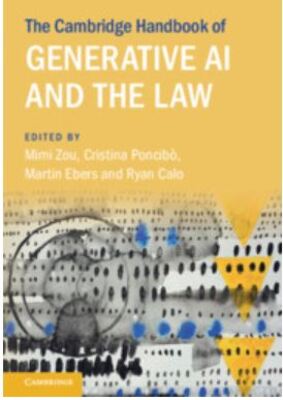
The Cambridge Handbook of Generative AI and the Law
Mimi Zou, Cristina Poncibò, Martin Ebers, and Ryan Calo
This handbook offers an important exploration of generative AI and its legal and regulatory implications from interdisciplinary perspectives. The volume is divided into four parts. Part I provides the necessary context and background to understand the topic, including its technical underpinnings and societal impacts. Part II probes the emerging regulatory and policy frameworks related to generative AI and AI more broadly across different jurisdictions. Part III analyses generative AI's impact on specific areas of law, from non-discrimination and data protection to intellectual property, corporate governance, criminal law and more. Part IV examines the various practical applications of generative AI in the legal sector and public administration. Overall, this volume provides a comprehensive resource for those seeking to understand and navigate the substantial and growing implications of generative AI for the law.
-
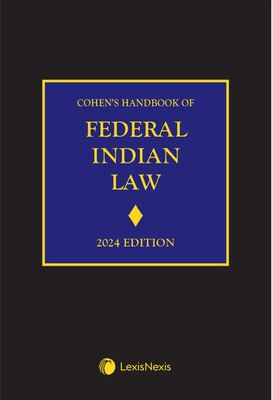
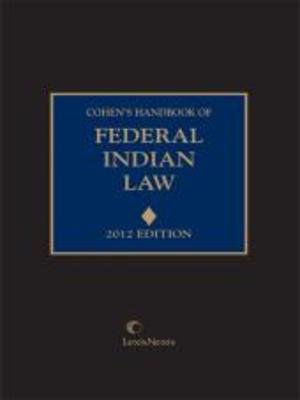
Cohen's Handbook of Federal Indian Law
Monte Mills
Cohen's Handbook of Federal Indian Law is an encyclopedic treatise written by experts in the field, and provides general overviews to relevant information as well as in-depth study of specific areas within this complex area of federal law. This is an updated and revised edition of what has been referred to as the bible of federal Indian law. This publication focuses on the relationship between tribes, the states and the federal government within the context of civil and criminal jurisdiction, as well as areas of resource management and government structure.
-
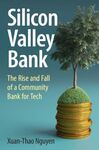
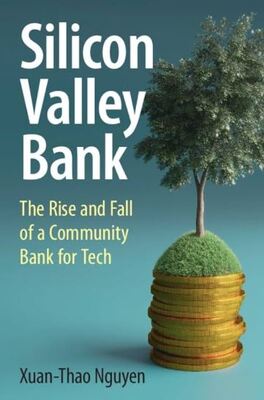
Silicon Valley Bank: The Rise and Fall of a Community Bank for Tech
Xuan-Thao Nguyen
This book provides a first-hand account of the founding, ascent, and dissolution of Silicon Valley Bank (SVB), a tech community bank founded in 1982 with US$5 million that became the nation's 13th largest bank and tech industry's lender and bank. In this pathbreaking work, which challenges conventional understanding of risky tech lending by showing how an independent community bank became the go-to bank for the tech industry in the United States, Xuan-Thao Nguyen includes interviews with key players, ranging from the original founders and early employees to the current CEO of SVB. Chapters explore how the relationship between the venture capital (VC) industry and SVB transformed the way commercial banks comply with banking regulators while lending and nurturing young tech clients. The book demonstrates why the relationships between investors, start-ups, bankers, lenders, experts, lawyers, regulators, and community leaders are key ingredients for ongoing innovation in the tech industry. The book concludes with the sobering dissection of SVB's sudden death by $142 billion cuts inflicted by tech bros, social media, and the Federal Reserve Bank's successive interest rate hikes to squash the overheated economy.
-

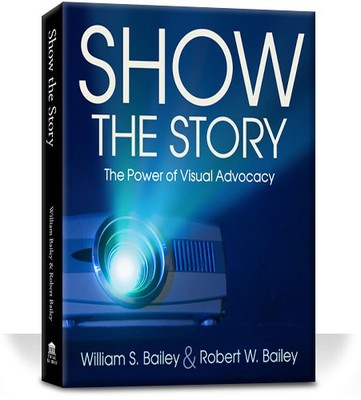
The Impact of the Digital Revolution on Modern Trials
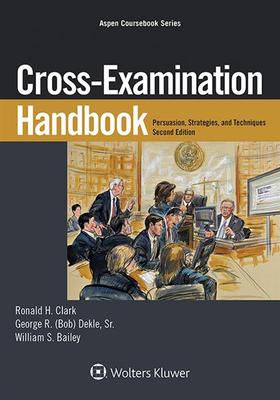
William S. Bailey
Trial advocacy in the twenty-first century requires lawyers to have a keen sense of the information needs of their audience, be it a judge or jurors. Breakneck changes in technology and internet use have propelled the blur of change to such a speed that is difficult to track. Trial lawyers must try and understand what all this means for the way that people process information and make decisions. In this article, William S. Bailey discusses the need to develop a style that seamlessly incorporates illustrations and animations with verbal arguments and questioning witnesses.
-

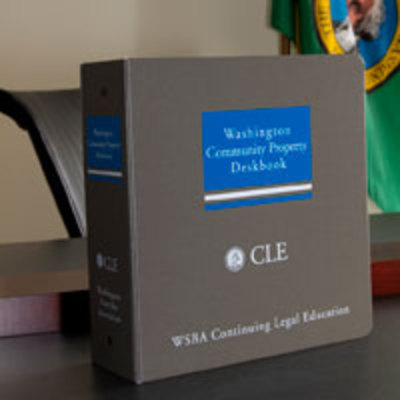
Washington Community Property Deskbook (5th ed.)
Karen Boxx
The 2023 fifth edition of the indispensable reference on community property law in Washington was updated by University of Washington School of Law Professor Karen Boxx, who is also of counsel at Keller Rohrback LLP, a Fellow in the American College of Trust and Estate Counsel (ACTEC), and a Uniform Law Commissioner for the state of Washington.
This new edition covers developments in Washington community property law since the 2014 fourth edition, with in-depth chapters on:
- the necessary relationship for community property to be created (valid marriage or a registered domestic partnership);
- the character of ownership of property;
- management and voluntary disposition of property;
- transactions and agreements between married persons, registered domestic partners, and committed intimate partners;
- involuntary disposition of property and creditors’ rights;
- federal taxation; and
- the transitory community and conflict of laws.
The new edition also addresses in detail the much-neglected topic of the applicability of Washington's community property system to Native Americans in the chapter dealing with conflict of laws, because Indian law issues necessarily arise at the intersection of state, federal, and tribal law.
-
The ACTEC Commentaries on the Model Rules of Professional Conduct, 6th ed.
Karen Boxx and J. Lee Osborne
The Sixth Edition of the ACTEC Commentaries addresses changes to the estate planning and probate practice, and the practice of law in general, since 2015 when the Fifth Edition was published. In that time period, the worldwide pandemic accelerated the use of technology in the practice and changes to the formalities of document execution that had been in place for centuries. Those developments in turn require reconsideration of the lawyer’s ethical duties when using the new methods of communication. In addition, this Edition has been updated to reflect increasing concern about elder abuse and the dilemma of the client with diminishing capacity. Other changes reflect changes in family law and issues that have been addressed in cases and ethics opinions around the country since the last Edition.
There have not been significant changes to the ABA Model Rules since the last Edition. Other laws may affect and regulate a lawyer’s duties, such as duties regarding reporting of elder abuse or child abuse. There have been no final changes to the regulation of lawyers with respect to financial transaction reporting since the last Edition, but the work of the Financial Action Task Force is ongoing and further regulation is expected. In addition to changes to the Model Rules and applicable state ethics rules and opinions, attorneys must keep up with changes to those other laws, including regulation aimed at combatting money laundering, that affect attorney duties and reporting requirements. The recommendations in this Edition are current as of September 2022, but are likely to be affected by further developments.
As Reporters, we thank the many who contributed to the Sixth Edition but give special acknowledgment to Professor Elizabeth Carter, who served as co-chair of the Commentaries 6th edition subcommittee, Andrew Rothstein, Christopher Gadsden, Janet Montgomery, Kevin McCrindle, Mary Radford, Peter Mott, Richard Gorini, Steven Benefield, Amy Hess, and William Hennessey, who served on the Commentaries 6th edition subcommittee, Linda Retz, who served as Chair of the Professional Responsibility Committee at the beginning of this process, created the plan for the project to be accomplished, and kept the project moving throughout the pandemic, and to all members of the Professional Responsibility Committee of ACTEC for their efforts on this project. We also express appreciation to the reporters for the previous editions: John R. Price, Reporter for the First and Second Editions; Bruce S. Ross, Reporter for the Third Edition; Charles Bennett and Cynda Ottaway, Co-Reporters for the Fourth Edition; and Thomas A. Andrews, Co-Reporter for the Fifth Edition. Finally, we commend and thank the ACTEC Foundation for its ongoing support of the ACTEC Commentaries, which continue to provide important guidance to the bench, bar and public sector.
-
Software Law and Its Application, Third Edition
Robert W. Gomulkiewicz
Software Law and Its Application, Third Edition covers the statutes, cases, and regulations that provide legal protection for computer software with a practice-focused approach.
-
Licensing Intellectual Property: Law and Application, Fifth Edition
Robert W. Gomulkiewicz, Xuan-Thao Nguyen, and Danielle M. Conway
Intellectual property is among the most important and interesting areas of law, thanks to its close link to the technological innovation sweeping society. But it is not enough to simply own patents, copyrights, trademarks, and trade secrets—inventors and creators need to put these intellectual property assets to productive use. Licensing is the most important way to do that. Licensing Intellectual Property: Law and Application provides students of varied backgrounds with an understanding of the legal principles and licensing models available to help clients accomplish their business objectives. This book is for courses focusing on the law of licensing and the application of licensing in practice. In particular, the book’s extensive drafting and client counseling exercises provide students the opportunity to develop their skills.
-
Native American Natural Resources Law: Cases and Materials
Monte Mills, Judith V. Royster, Michael C. Blumm, and Elizabeth A. Kronk Warner
Native American Natural Resources Law: Cases and Materials provides a thorough examination of the interconnection between land, religion, culture, and the law. The text includes basic Indian law history and focuses on aboriginal, treaty, and executive order title; allotment; and the intersection between Indian Country and surrounding lands. Special emphasis is placed on the tribal role in environmental protection, tribal natural resources development, and tribal taxation authority, as well as a detailed consideration of water rights and usufructurary rights to hunt, fish, and gather.
The fifth edition incorporates the many major developments in the law since the fourth edition, with expanded materials on momentous decisions of the United States Supreme Court, such as McGirt v. Oklahoma, and ongoing land management issues, including tribal-federal costewardship of places like Bears Ears National Monument and elsewhere; the numerous policy initiatives of the Biden administration aimed at reshaping the federal-tribal relationship; and important circuit court decisions related to water rights, the federal government's trust relationship with tribes, and much more.
-
The Law of Healthcare Administration
Sallie Thieme Sanford and J. Stuart Showalter
Healthcare leaders must navigate a complex and constantly evolving legal environment. The Law of Healthcare Administration provides a comprehensive and practical overview of healthcare law and its role in the management of healthcare organizations.
The tenth edition of this classic text explores substantial shifts in the legal landscape, including the effects of the COVID pandemic, the Dobbs v. Jackson Women’s Health Organization abortion rights decision, and Biden-era legislative and regulatory developments. J. Stuart Showalter and new co-author Sallie Thieme Sanford provide a broad perspective on a wide range of healthcare justice issues, using inclusive language and incorporating examples that involve various types of healthcare providers. -

Show the Brief: Visual Writing Strategies & Techniques
William S. Bailey
In Show the Brief: Visual Writing Strategies and Techniques, trial lawyer and law professor William S. Bailey teaches you how to create legal briefs that powerfully demonstrate the facts of your case in a more effective, and more persuasive, manner.
Over the last twenty-five years, the roles of both trial lawyers and judges have changed. Federal and state procedural rules encourage settlements more and more, often requiring pretrial discovery and alternative dispute resolution. Fewer cases go to trial today than they once did. As judges become increasingly willing to make sweeping pretrial rulings, either granting summary judgment on critical issues—or even out right dismissing a case—the stakes in pretrial motion practice have greatly increased. This has become particularly true in federal court, where outcomes are often far less favorable to plaintiffs overall.
In the intense, busy world of deciding civil cases on crowed dockets, briefs have become more important than ever: Most of the time, judges know how they are going to rule in a case after reading the briefs. They politely let you make your arguments, only to then announce the ruling knew they were going to make at the outset.
Briefs are your best shot to tell the judge why you should win, and why your opponent should lose. The court’s ruling will be driven by your case story and how it plays within the judge’s life experience, values, and understanding of the law.
Plaintiffs’ lawyers no longer have the luxury of reflexively sticking to tradition. You must take your best shot the first time, every time, in all pleadings and documents that you file with the court. The emphasis that once rested on trial now has shifted to pretrial, with depositions and motions often determining the way your case turns out. The time has come for you to use every tool you have in every aspect of your practice—not just during trial and trial preparation, but in each of the pleadings and briefs you file with the court. This means adopting the latest communications lessons from other professions and learning from the latest research in applied psychology to best present your case in every brief you file.
-
LexisNexis Practice Guide: Washington Probate and Estate Administration
Karen Boxx
LexisNexis Practice Guide: Washington Probate and Estate Administration is a practice-oriented resource designed to assist attorneys in guiding their clients through the probate and estate administration process. The author is a leading estates attorney in the state of Washington who has provided a wide variety of practice tips, examples and forms crucial to effective probate and estate administration in Washington. This practice guide includes in-depth analysis of topics such as: determining whether probate is necessary, identifying heirs and beneficiaries, creditors’ claims, and family protection.