-

Incorporating Experiential Education Throughout the Curriculum
Deborah Maranville, Cynthia Batt, Lisa Radtke Bliss, and Carolyn Wilkes Kaas
In discussing experiential education, Best Practices for Legal Education focused primarily on the three traditional types of separate experiential courses: in-house clinics, externships, and simulations, and treated them in a separate chapter. These courses were defined as those where “experience is a significant or primary method of instruction” rather than a secondary method, and where “students must perform complex skills in order to gain expertise.”
Arguably, this separate treatment reinforced what has too often been a divide between doctrinally-focused teaching and practice-focused teaching. Best Practices recognized that “experiential education can be employed as an adjunct to traditional methodologies regardless of class size” through methods such as incorporating simulation exercises into doctrinally-focused courses. It did so, however, only as part of its discussion of best practices for legal education generally.
This section builds on Best Practices by emphasizing the need to incorporate experiential education throughout the curriculum in order to maximize its educational impact. The term “experiential education” is, therefore, used to encompass both separate experiential courses and what will be termed “experiential modules.” Because a key distinction in experiential education is between simulated and real experiences, the term “clinical legal education” will be restricted to separate courses involving real experiences—law clinics, externships and offerings using alternative models, often termed “hybrids.” The term “law clinics” will be used to include both traditional in-house clinics taught by full-time faculty, and other structures that provide a similar level of intensive, integrated teaching and supervision.
As Best Practices suggested, it is helpful to distinguish “experiential learning” and “experiential education.” Both happen in law school, and in life; both are important. Experiential learning is simply a primary way that people learn on their own, whereas experiential education involves active and purposeful design and teaching. A focus on experiential education directs law schools and individual legal educators to their role in ensuring that maximum learning takes place beyond raw experience. The way in which each teacher integrates experiential education methods will often determine how far the students develop as lawyers in response to those methods. The way in which a law school designs and delivers a coherent array of courses to allow a student to progress from novice to (reasonably) competent professional in three short years will, more and more, define its efficacy, reputation, and leadership as a provider of legal education.
-

Faculty Status and Institutional Effectiveness
Deborah Maranville, Ruth Anne Robbins, and Kristen K. Tiscione
Legal education has expanded to incorporate practice-oriented topics and courses over the past several decades, and student academic support services have multiplied in response to changing student populations. As a consequence of these changes, law schools are overdue to address the issue of the status of the individuals they hire to fill the multiple and ever expanding needs and interests of students.
Should law schools hire new personnel as teachers, staff, or administrators? If hired as teachers, what titles and governance rights should they be given? Should they be eligible for tenure, presumptively renewable long-term contracts, or short-term contracts? What workloads are appropriate and what courses permitted?
Status and fairness issues for law teachers accompanied the rise of experiential programs, including clinical and legal research and writing programs. More recently, similar issues have arisen with academic support teachers, whose courses may be mandatory for certain students, and have intensified for externship teachers at many schools.
Best Practices for Legal Education identified as a “best practice to enhance the effectiveness of faculty in experiential courses” that “a school uses qualified faculty, provides professional development opportunities, and assigns reasonable workloads in its experiential education courses.”
Faculty status is a key dimension of enhancing the effectiveness of faculty, and this section provides an overview of the issues involved in debates over faculty status.
-

The Socratic Method
Elizabeth G. Porter
The Socratic method, one of Langdell’s most well-entrenched reforms to legal education, remains the law’s signature pedagogical technique. Although the term means different things to different people, its essence in the law school classroom is student analysis of cases led by a teacher, who calls on students to articulate gradually deeper understandings of a legal doctrine or theory.
Socratic learning requires students to think on the spot, answer precisely, and take intellectual risks. For over a decade now, the Socratic method has been out of fashion among those who write about legal pedagogy. In addition, the method’s critics describe what they view as the alienation and humiliation of students, an inattention to legal theory and professionalism, and a lack of clear learning outcomes.
Indeed, both Best Practices for Legal Education and Educating Lawyers: Preparation for the Profession of Law criticized or downplayed the value of the Socratic method. Best Practices concluded that the Socratic method should be “used sparingly.”
These critiques undervalue the Socratic method. As the Carnegie Report acknowledged, the Socratic method is an easily scalable, effective, deeply engaging way to achieve active student learning, particularly but not only in larger doctrinal classes. Similarly, Best Practices recognized that “[t]ailored and applied flexibly, the case method . . . can provide a logical, overall methodology for approaching and thinking about all sorts of situations.” Those positive findings remain true. The Socratic method gives students a strong incentive to prepare well for class every day, and during class it forces both students and the teacher to focus intensely, to listen to others, and to express their ideas in a cogent, persuasive, and professional manner.
These qualities—thorough preparation, focus, listening skills, cogent analysis, and good judgment—are fundamental to successful lawyering. Finally, contrary to its reputation, the Socratic method is also a wonderful way to create a sense of community and shared learning purpose among students, even in a large class. These attributes of Socratic teaching look even stronger in comparison with the most commonly used alternative—lectures, perhaps punctuated by text-heavy PowerPoint slides.
Indeed, while the method has fallen from favor in law schools, cutting-edge colleges are now seeking to expand Socratic-type interactive teaching in order to raise the level of engagement among students. In recognition of the continuing centrality and vitality of the Socratic method, this section therefore focuses on best practices for optimizing the effectiveness of this active learning style. The basics of the Socratic method are well described elsewhere (and will have been experienced by almost all readers of this volume).Therefore, this section will not describe the methodology in detail. Instead, it will situate the Socratic method within a framework describing the level of active learning of the most frequently used pedagogical techniques in the non-clinical law school classroom. Then it will focus on three fundamental tools for creating and maintaining a successful course that uses the Socratic method for active learning.
-

Post-Racial Proxy Battles over Immigration
Mary D. Fan
Amid economic and political turmoil, anti-immigrant legislation has flared again among a handful of fiercely determined states. To justify the intrusion into national immigration enforcement, the dissident states invoke imagery of invading hordes of “illegals”—though the unauthorized population actually fell by nearly two-thirds, decreasing by about a million people, between 2007 and 2009 as the recession reduced the lure of jobs.
Arizona’s Senate Bill 1070—recently invalidated in part by the U.S. Supreme Court in Arizona v. United States—led the charge. By preelection-year summer 2011, several states enacted laws patterned after Arizona’s controversial Senate Bill 1070, including Alabama’s even more aggressive HB 56. A host of lawsuits are pending against the new laws, which are at least partially invalid after Arizona v. United States. Other controversial proposals circulate, such as eliminating birthright citizenship or branding the birth certificates of alleged “anchor babies” implanted in the United States by foreigners.
This chapter examines how the spurt of state legislation is a proxy way to vent resurgent racialized anxieties and engage in friend-enemy politics founded on conflict with the “Other”—the foreign enemy within—in a time of economic and political turmoil. Despite the ostensibly a-racial construct of the illegal alien used to legitimize the lashing out, it is suffused with racialized perception. Current tactics parallel the overtly racialized hostility of past episodes of states enacting out anti-immigrant legislation. The oft-raised concern in such a fiercely polarized time is racial discrimination. Antidiscrimination law, however, does not offer the remedy for this concern.
Part 1 analyzes two hot-button forms of resurgent state and local anti-“alien” laws of our times—laws patterned on the Arizona template and the anti–birthright citizenship movement. It explores the dominance of racialized anxieties behind the seemingly race-neutral construct of the vilified alien. Part 2 contrasts the friend-enemy politics and legislation of our contemporary scene with the state and local legislation and furor against the Chinese during the turbulent politics of the last quarter of the nineteenth century. Part 3 examines the polarization-ameliorating bases for decisions to cut back on overreaching state and local laws in order to make shared interests, rather than racial difference, salient while protecting underlying antidiscrimination values. The approach helps build bridges between dissonant worldviews to navigate the profoundly polarized politics and legislation of our times.
-
Cause Lawyering in Japan: Reflections on the Case Studies and Justice Reform
Daniel H. Foote
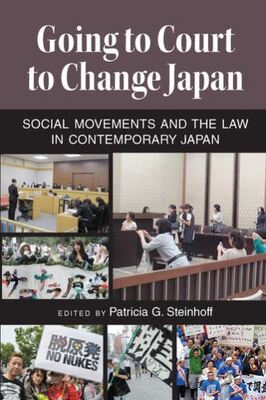
Each of the case studies presented in this volume is an important and fascinating story in its own right. Taken together, the case studies enrich our understanding of cause lawyering and the relationship between law and social change in Japan. Despite their rather disparate subjects, the studies dovetail exceptionally well. They show numerous commonalities in the use of law to further social causes, as well as some important differences. They reveal a truly impressive level of creativity in the use of law, and they disclose several common barriers to successful litigation to promote social causes in Japan. As discussed below, a number of recently introduced reforms seek to ameliorate some of those barriers. As these case studies so eloquently show, however, the goal of socially oriented litigation at times is not victory in the court battle itself, but rather victory in the court of public opinion. In short, although this book is entitled Going to Court to Change Japan, the courts are only one locus in a much broader battle.
-

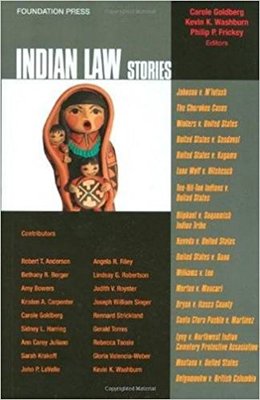
Aboriginal Title in the Canadian Legal System: The Story of Delgamuukw v. British Columbia
Robert T. Anderson
Canada is grappling with legal issues surrounding indigenous property rights on a scale not seen in the United States since the mid-nineteenth century. Fundamental questions of fairness and justice related to indigenous peoples’ property rights are in flux in the province of British Columbia–an area the size of the states of California, Oregon, and Washington combined. The recognition of aboriginal rights in the Canadian Constitution in 1982 and recent judicial developments made it clear to the provincial government that nearly the entire province may be subject to aboriginal title claims. Consequently, the aboriginal nations and B.C. government have embarked on a treaty process to resolve conflicting interests, but not in the fashion utilized in the United States.
In the U.S., treaties and agreements with Indian tribes generally resulted in the extinguishment of all indigenous property rights in sweeping terms. In addition, payment of compensation pursuant to the Indian Claims Commission process extinguished legal claims to lands taken previously without payment of compensation. To be sure, most of the roughly three hundred tribes in the contiguous forty-eight states reserved homelands, or were moved to other areas set aside for their use and occupancy, and some retained extensive rights to access off-reservation wildlife resources.
In British Columbia, however, no earlier treaties ceded aboriginal lands, and the provincial government has recognized that the “extinguishment” of aboriginal title is unacceptable to aboriginal nations. There are over sixty aboriginal nations engaged in forty-nine sets of negotiations with a stated goal of reconciling aboriginal rights and title with the fact the non-aboriginal people and governments are in Canada to stay. This chapter explores the foundation beneath the current negotiations.
-
Preface
William H. Rodgers Jr.
In the 2006-07 term, the U.S. Supreme Court gave us a flood of new thought on the topic of environmental law.
Too bad.
[Addresses cases interpreting the Clean Water Act, the Superfund law, the Clean Air Act, and the Endangered Species Act. In the Summer 2008 Pocket Part for Volume 1.]
-
Washington: The Past and Present Populist State
Hugh D. Spitzer
Describes the impact of the late-nineteenth century populist movement on the structure and content of Washington’s constitution and the consequential impact on the state’s political and legal life. Suggests that the anti-business attitudes and skepticism about government prevalent among Washington State residents in the 1880s and 1890s, continues to influence that state's constitution, laws and politics today.
-
Banking Law
Penny A. Hazelton
- Introduction
- Federal Law
- State Law
- Federal Regulatory Framework
- Office of the Comptroller of the Currency
- Office of Thrift Supervision
- Board of Governors of the Federal Reserve System
- Federal Deposit Insurance Corporation
- Resolution Trust Corporation
- Federal Housing Finance Board
- Federal Home Loan Bank System
- State Regulatory Framework
- Additional Research Sources
- Appendices
-
![Keiken, tayōsei, soshite hō [Experience, Diversity, and the Law] by Daniel H. Foote](https://digitalcommons.law.uw.edu/faculty-chapters/1056/thumbnail.jpg "Keiken, tayōsei, soshite hō [Experience, Diversity, and the Law] by Daniel H. Foote")
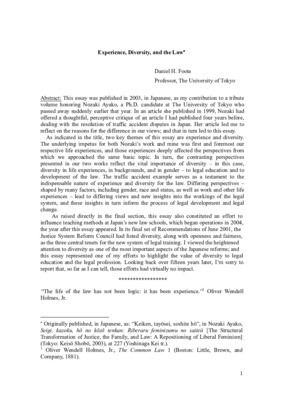
Keiken, tayōsei, soshite hō [Experience, Diversity, and the Law]
Daniel H. Foote
This essay was published in 2003, in Japanese, as my contribution to a tribute volume honoring Nozaki Ayako, a Ph.D. candidate at The University of Tokyo who passed away suddenly earlier that year. In an article she published in 1999, Nozaki had offered a thoughtful, perceptive critique of an article I had published four years before, dealing with the resolution of traffic accident disputes in Japan. Her article led me to reflect on the reasons for the difference in our views; and that in turn led to this essay. As indicated in the title, two key themes of this essay are experience and diversity. The underlying impetus for both Nozaki’s work and mine was first and foremost our respective life experiences, and those experiences deeply affected the perspectives from which we approached the same basic topic. In turn, the contrasting perspectives presented in our two works reflect the vital importance of diversity – in this case, diversity in life experiences, in backgrounds, and in gender – to legal education and to development of the law. The traffic accident example serves as a testament to the indispensable nature of experience and diversity for the law. Differing perspectives – shaped by many factors, including gender, race and status, as well as work and other life experiences – lead to differing views and new insights into the workings of the legal system, and these insights in turn inform the process of legal development and legal change.
As raised directly in the final section, this essay also constituted an effort to influence teaching methods at Japan’s new law schools, which began operations in 2004, the year after this essay appeared. In its final set of Recommendations of June 2001, the Justice System Reform Council had listed diversity, along with openness and fairness, as the three central tenets for the new system of legal training. I viewed the heightened attention to diversity as one of the most important aspects of the Japanese reforms; and this essay represented one of my efforts to highlight the value of diversity to legal education and the legal profession. Looking back over fifteen years later, I’m sorry to report that, so far as I can tell, those efforts had virtually no impact.
-
Indian Law Research in Washington
Penny A. Hazelton
- Introduction
- Federal Indian Policy
- Indian Law Terminology
- Scope of Federal, Tribal, and State Power over Indians
- Practitioner's Checklist
- Research Tools
- Conclusion
- Washington State Tribal Directory
- Basic Rules of Jurisdiction in Indian Country (Criminal)
-
The Process of Legal Research
Penny A. Hazelton
- Introduction
- Formats of Legal Materials
- Integrating the Use of Print and Electronic Tools in Legal Research
- Strategies for Effective Legal Research
- Managing Your Legal Research
- Comparison of Major Legal Research Texts
- "'Here There Be Dragons': How to Do Research in an Ara You Know Nothing About"
- "Develop the Habit: Note-Taking in Legal Research"
-
Banking Law
Penny A. Hazelton
- Introduction
- Federal Law
- State Law
- Federal Regulatory Framework
- Office of the Comptroller of the Currency
- Office of Thrift Supervision
- Board of Governors of the Federal Reserve System
- Federal Deposit Insurance Corporation
- Resolution Trust Corporation
- Federal Housing Finance Board
- Federal Home Loan Bank System
- State Regulatory Framework
- Additional Research Sources
- Appendices
-
Banking Law
Penny A. Hazelton
- Introduction
- Federal Law
- State Law
- Federal Law Framework
- Office of the Comptroller of the Currency
- Office of Thrift Supervision
- Board of Governors of the Federal Reserve System
- Federal Deposit Insurance Corporation
- Resolution Trust Corporation
- Federal Housing Finance Board
- Federal Home Loan Bank Board
- State Regulatory Framework
- Additional Research Sources
- Appendices
-
The Process of Legal Research
Penny A. Hazelton
- Introduction
- Strategies for Effective Legal Research
- Integrating Manual and Computerized Legal Research Tools
- Managing Your Legal Research
-
How to Use a Law Library
Penny A. Hazelton and Peggy Roebuck Jarrett
- Getting Acquainted
- People in Libraries
- Collection Organization
- Access to the Collection
- Access to the Contents of the Library Collections
- Access to Legal Information Without Leaving the Comfort of Your Home or Office
- Appendix 1, Law Libraries in Washington State
- Appendix 2, Free or Low Cost Advocacy, Information, and Referral fr King County Residents
-
Banking Law
Penny A. Hazelton
- Introduction
- Federal Law
- State Law
- Federal Regulatory Framework
- Office of the Comptroller of the Currency
- Board of Governors of the Federal Reserve System
- Federal Deposit Insurance Corporation
- Federal Home Loan Bank Board
- Office of Thrift Supervision
- State Regulatory Framework
- Additional Research Sources
- Appendices
Printing is not supported at the primary Gallery Thumbnail page. Please first navigate to a specific Image before printing.